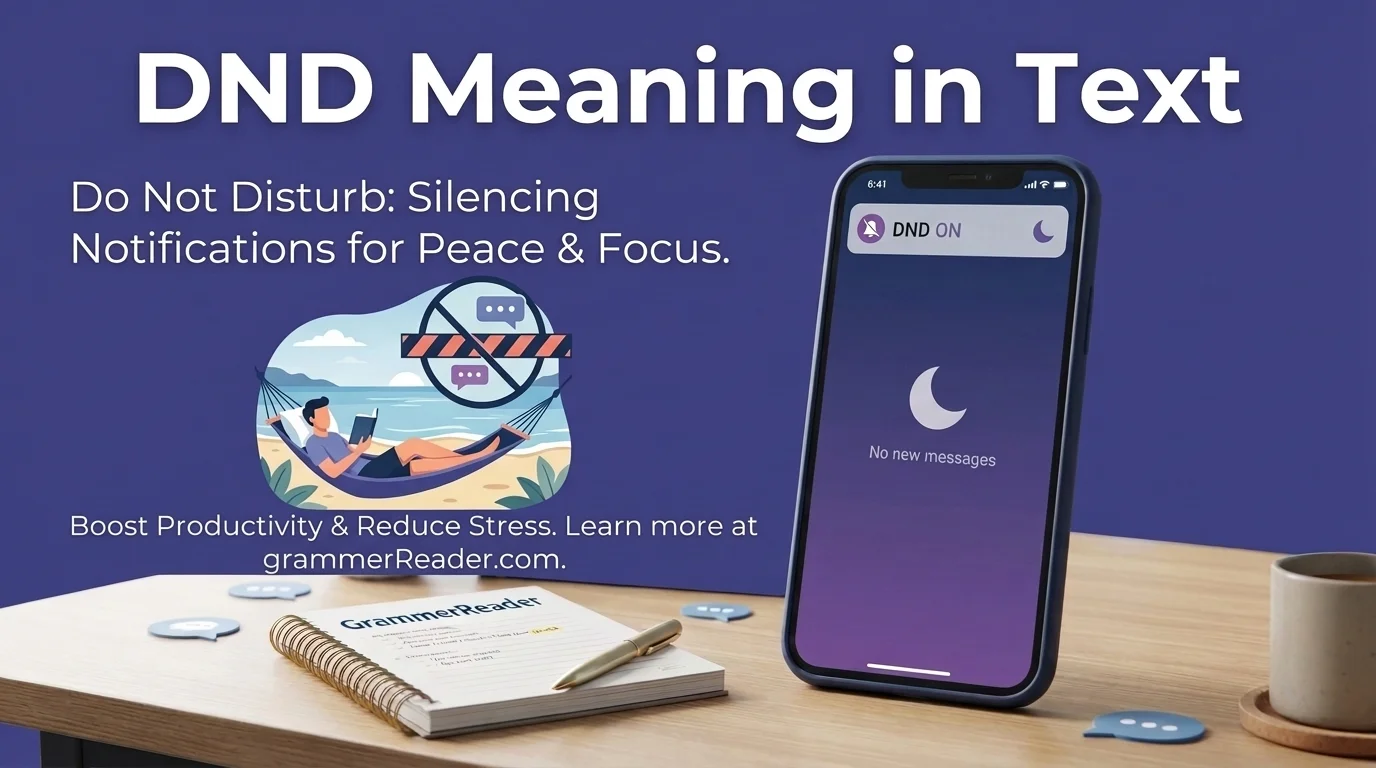
If you have received a text saying “I’m on DND” or noticed someone mention “DND” in a chat, you may wonder what they mean. The phrase dnd meaning in text most commonly refers to “Do Not Disturb.” It is commonly used when someone does not want to receive notifications, calls, or interruptions for a period of time.
However, the exact meaning can depend on the platform, conversation, and context. In some situations, especially among gamers, “DND” can also refer to Dungeons & Dragons, the popular tabletop role-playing game.
Understanding the surrounding conversation is therefore important. In everyday texting and phone-related conversations, “Do Not Disturb” is generally the meaning people intend. This guide explains how DND is used in texts, social media, messaging apps, gaming chats, and different types of conversations.
Quick Answer
DND in text most commonly means “Do Not Disturb.” Someone may use it to say they are unavailable, don’t want notifications, or are temporarily avoiding interruptions. In gaming conversations, however, DND can also mean Dungeons & Dragons, so context matters.
What Does DND Meaning in Text Mean?
The most common DND meaning in text is “Do Not Disturb.”
“Do Not Disturb” is a setting available on smartphones and many digital devices. When someone enables it, notifications, calls, or alerts may be silenced or limited according to their settings.
People also use “DND” informally in messages to explain that they do not want to be interrupted.
For example:
“I’m studying, DND please.”
This means:
“I’m studying, so please do not disturb me.”
You may also see variations such as:
- “I’m on DND.”
- “DND right now.”
- “Going DND.”
- “Sorry, I was on DND.”
- “Put your phone on DND.”
- “DND until tomorrow.”
The meaning is usually straightforward when the conversation is about phones, notifications, work, studying, sleeping, or being unavailable.
However, DND has another well-known meaning Dungeons & Dragons. If the conversation is about tabletop games, characters, campaigns, dice, or role-playing, DND may refer to the game rather than “Do Not Disturb.”
What Does It Mean in a Text Conversation?
In everyday texting, “DND” usually communicates temporary unavailability or a request for fewer interruptions.
Someone might say they are on DND because they are:
- Studying
- Working
- Sleeping
- Watching a movie
- Driving
- Busy with something important
- Taking a break from notifications
- Trying to concentrate
The tone is normally neutral and casual.
For example:
Person A: Are you free to talk?
Person B: Not right now, I’m on DND.
Here, the person is simply explaining that they are currently unavailable.
DND can also sound friendly:
“I’m going on DND for a few hours. Talk later!”
It can become more direct depending on the wording:
“DND. Don’t call me.”
The abbreviation itself isn’t rude. The surrounding words determine whether the message feels polite, blunt, playful, or irritated.
DND is especially common in digital communication because smartphones and messaging apps make “Do Not Disturb” a familiar concept. It is not limited to teenagers or Gen Z; people of different ages may use it when talking about phones, notifications, or availability.
Examples of DND Meaning in Text Messages
Here are realistic examples showing how DND meaning in text can change slightly depending on the situation.
Example 1: Studying
A: Can I call you?
B: Not now, I’m on DND studying.
Meaning: B has enabled Do Not Disturb because they want to focus on studying.
Example 2: Sleeping
A: Why didn’t you answer my messages?
B: Sorry, I was asleep with my phone on DND.
Meaning: DND helped prevent notifications from interrupting B’s sleep.
Example 3: Working
A: Did you see my message?
B: I was on DND during work. Just saw it.
Meaning: B temporarily silenced notifications while working.
Example 4: Asking Someone to Stop Interrupting
A: I’ll keep sending memes 😂
B: Haha, I’m putting my phone on DND now.
Meaning: B is jokingly saying they are going to stop receiving notifications.
Example 5: Taking a Break
A: Where have you been?
B: Took a little break and went DND for the afternoon.
Meaning: B intentionally disconnected from notifications for a while.
Example 6: Concentrating
A: Want to play?
B: Later. DND mode while I finish this project.
Meaning: B is concentrating and doesn’t want interruptions.
Example 7: Explaining a Missed Call
A: I called twice!
B: Sorry! My phone was on DND.
Meaning: The person explains why they did not notice or respond to the calls.
Example 8: Polite Boundary
A: Can we chat tonight?
B: Maybe tomorrow. I’m keeping my phone on DND tonight.
Meaning: B is setting a polite boundary and asking for uninterrupted time.
Example 9: Group Chat
A: Everyone, who’s coming?
B: I might not respond for a while. I’m on DND.
Meaning: B is letting the group know they may not see messages immediately.
Example 10: Gaming Context
A: Are we playing DND tonight?
B: Yes! I finished my character sheet.
Meaning: Here, DND means Dungeons & Dragons, not Do Not Disturb. The gaming context makes the intended meaning clear.
Different Meanings of DND
Although “Do Not Disturb” is the most common texting-related meaning, DND can represent different things depending on the conversation.
| Meaning | Context | Example | Tone |
|---|---|---|---|
| Do Not Disturb | Phones, texting, notifications | “I’m on DND.” | Neutral/casual |
| Dungeons & Dragons | Tabletop gaming and role-playing | “Are we playing DND tonight?” | Casual/enthusiastic |
| Do Not Disturb | Personal boundaries | “DND for the next hour.” | Direct/neutral |
| Do Not Disturb | Work or studying | “Putting my phone on DND.” | Practical |
The most common meaning in ordinary texting is “Do Not Disturb.” The gaming meaning becomes much more likely when the conversation involves characters, campaigns, dice, fantasy adventures, or tabletop gaming.
Context is therefore more reliable than the abbreviation by itself.
What Does DND Mean on Different Platforms?
Text Messages
In regular SMS or messaging conversations, DND generally means Do Not Disturb. Someone may use it to explain why they aren’t responding or why they don’t want calls.
On WhatsApp, someone might say:
“I’m on DND, I’ll reply later.”
This usually means they have chosen not to deal with notifications at that moment. It does not necessarily mean they have blocked anyone.
Snapchat
A Snapchat user might use “DND” in a message, status, or conversation to communicate that they are unavailable or taking a break from notifications.
TikTok
On TikTok, DND can appear in comments, direct messages, captions, or conversations. The meaning depends on context. In general, “Do Not Disturb” is likely when the discussion concerns being busy or unavailable.
Instagram users may use DND in DMs or captions to indicate that they are taking a break from notifications or don’t want to be contacted for a while.
On Facebook Messenger or Facebook posts, DND can similarly mean “Do Not Disturb.” However, a gaming-related discussion could use DND to mean Dungeons & Dragons.
Discord
Discord is particularly context-dependent. Someone discussing notifications or availability may mean Do Not Disturb, while a gaming community discussing tabletop role-playing may use DND for Dungeons & Dragons.
Gaming Chats
In gaming communities, DND can have two possible meanings. If players are talking about their status or notifications, it may mean “Do Not Disturb.” If they’re discussing tabletop role-playing, characters, campaigns, or fantasy adventures, it may mean Dungeons & Dragons.
Is DND Positive, Negative, or Rude?
DND is usually neutral. The abbreviation itself does not automatically communicate anger or rudeness.
The tone depends on the surrounding message.
Friendly Usage
“Going on DND for a bit 😊 Talk later!”
This sounds friendly and simply communicates temporary unavailability.
Neutral Usage
“I’m on DND while I study.”
This is factual and straightforward.
Funny Usage
“DND mode activated. My homework has defeated me 😂”
The abbreviation is being used playfully.
Potentially Rude Usage
“DND. Stop texting.”
The meaning is still “Do Not Disturb,” but the wording makes the message sound blunt.
Capitalization, punctuation, and emojis can also affect how the message feels. Compare:
“I’m on DND, talk later!” — friendly
“DND.” — short and potentially blunt
“DND 😂” — playful
“Please don’t disturb me right now.” — direct but clear
So, don’t assume someone is angry simply because they use “DND.”
How Should You Reply?
Your response should depend on the context and your relationship with the person.
1. Casual
“Okay, talk later!”
2. Friendly
“No worries! Take your time.”
3. Polite
“Sure, I’ll message you later.”
4. Supportive
“Got it. Hope you get some uninterrupted time!”
5. Funny
“DND mode accepted 😂”
6. Direct
“Okay, let me know when you’re available.”
7. Professional
“Understood. I’ll follow up when you’re available.”
8. Clarifying
“Sure. Do you mean you’re on Do Not Disturb?”
This last response can be useful when you’re unsure whether “DND” means Do Not Disturb or Dungeons & Dragons.
Similar Texting Abbreviations or Expressions
DND belongs to a broader group of digital expressions related to availability, notifications, and messaging.
AFK
AFK means “Away From Keyboard.” It is particularly common in gaming and online communities.
BRB
BRB means “Be Right Back.” Someone uses it when temporarily leaving a conversation.
TTYL
TTYL means “Talk To You Later.” It is a casual way to end a conversation temporarily.
GTG
GTG usually means “Got To Go.” It tells someone that you need to leave or stop chatting.
BBL
BBL means “Be Back Later.”
Offline
Someone saying they are “offline” generally means they are not currently available online.
Busy
“Busy” is a simple alternative to DND when someone wants to communicate that they cannot respond immediately.
AFK Mode
“AFK mode” is another informal way of saying that someone is temporarily away or unavailable, especially in gaming contexts.
Common Misunderstandings
One of the biggest misunderstandings about DND is assuming that it always means Do Not Disturb.
While that is the most common meaning in ordinary texting, DND can also mean Dungeons & Dragons.
For example:
“I’m playing DND tonight.”
This most likely refers to the tabletop role-playing game, not a phone setting.
Another common misunderstanding is assuming that someone on DND is deliberately ignoring a specific person. Not necessarily. A person may have enabled Do Not Disturb for everyone because they’re studying, sleeping, working, or simply taking a break.
It is also important to remember that Do Not Disturb settings vary by device and app. Someone may still receive certain calls or alerts depending on how their settings are configured.
Finally, “DND” does not automatically mean “I don’t want to talk to you.” The context and wording matter.
Frequently Asked Questions
What does DND mean in text?
DND most commonly means “Do Not Disturb” in text messages. Someone may use it to say they are temporarily unavailable, don’t want notifications, or are focusing on something. However, DND can also mean Dungeons & Dragons in gaming conversations, so the surrounding context helps determine the intended meaning.
What does DND mean from a boy?
If a boy texts “DND” in an ordinary conversation, it generally means “Do Not Disturb.” He may be saying that his phone is on Do Not Disturb or that he doesn’t want interruptions at that moment. The abbreviation by itself does not indicate a particular romantic feeling or hidden message.
What does DND mean from a girl?
If a girl uses “DND” in a regular text conversation, it generally means “Do Not Disturb.” She may be busy, studying, sleeping, working, or taking a break from notifications. The exact reason depends on the surrounding conversation and what she says with the abbreviation.
Is DND rude?
No, DND is not inherently rude. It is normally a neutral abbreviation for “Do Not Disturb.” However, a very short message such as “DND. Don’t text me” can sound blunt because of the wording. A message such as “I’m on DND for a while, talk later!” usually sounds much friendlier.
Is DND flirting?
DND is not normally a flirting abbreviation. In most texting situations, it simply means “Do Not Disturb.” If someone uses it during a playful or romantic conversation, the surrounding messages may give the conversation a different tone, but DND itself does not specifically mean flirting.
Does DND have another meaning?
Yes. Besides “Do Not Disturb,” DND commonly refers to “Dungeons & Dragons,” a tabletop role-playing game. Context makes the difference. Phone, notification, work, and study conversations usually point to “Do Not Disturb,” while gaming conversations may indicate “Dungeons & Dragons.”
Final Thoughts
The most common DND meaning in text is “Do Not Disturb.” It is usually used when someone wants to communicate that they are unavailable, focusing on something, sleeping, working, or temporarily avoiding notifications. The abbreviation is generally neutral and is not automatically rude or unfriendly.
However, DND can also mean Dungeons & Dragons, especially in gaming conversations. If you’re unsure which meaning someone intends, look at the surrounding words and topic before interpreting the message.
A phrase like “I’m on DND Meaning in Text” almost certainly relates to notifications, while “We’re playing DND tonight” may refer to the tabletop game. Understanding context is the easiest way to interpret this common online abbreviation correctly.

Grace Wilson is a passionate writer and language enthusiast who enjoys exploring word meanings and making complex ideas easy to understand.